Perimenopause Symptoms Starting in the Early Forties
Hormonal swings, not simple decline, explain why perimenopause symptoms hit hard in your forties.
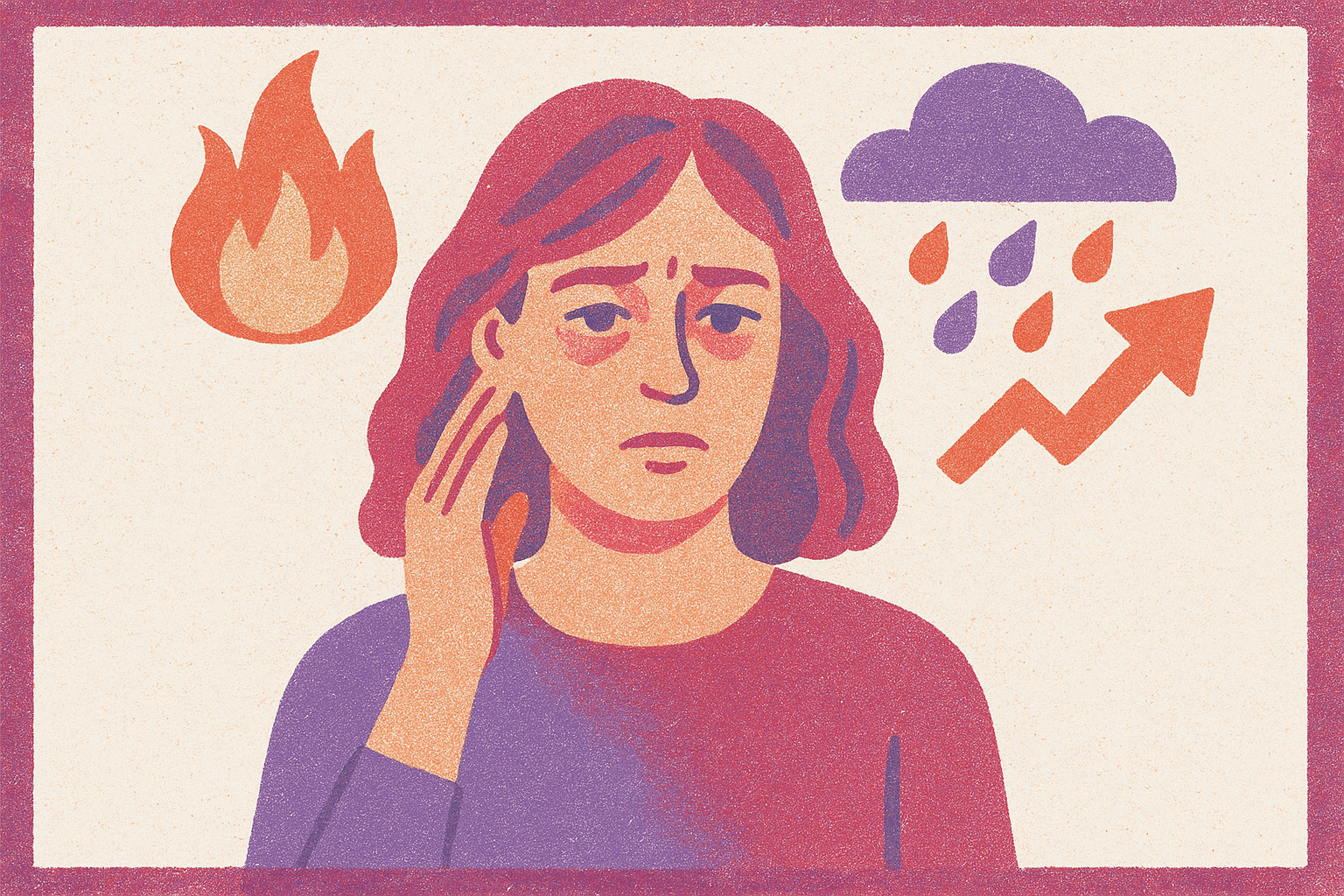
A woman in her early forties notices her cycle has gone erratic, her sleep is fractured, and her mood swings in ways that feel foreign to her. She assumes something has gone wrong. What the data actually shows is that her body is running exactly on schedule, following a hormonal sequence that starts, for most women, well before menopause itself arrives.
What perimenopause actually is, and when the transition officially begins
Perimenopause means "around menopause," and that word choice matters more than it first appears. It is not a single event or a diagnosis a doctor hands down on one visit. It is a transitional stretch of years, and it only ends once a woman has gone 12 consecutive months without a period, the point clinicians actually call menopause, which arrives at an average age of 52 in the United States.
The stretch leading up to that point averages around 4 years but can run anywhere from 2 to 10. That means some women spend the better part of a decade in this transition, which is a long time to feel uncertain about what's happening in your own body.
The clinical framework used to stage this process is a staging system that was revised in 2012 from an original 2001 model, and it remains the reference point most reproductive endocrinologists work from. It breaks the reproductive lifespan into stages, moving from the late reproductive phase into early and then late perimenopause. Early perimenopause, Stage -2 in the system, is marked by cycles that vary by more than 7 days, alongside the first hormone fluctuations and symptoms: disrupted sleep, mood changes, vaginal dryness, shifts in libido, brain fog. Late perimenopause, Stage -1, shows up when cycles start spacing out more than 60 days apart, usually in the late forties to early fifties, and typically lasts 1 to 3 years before menopause itself.
STRAW+10 applies regardless of age, ethnicity, body size, or lifestyle, which means a woman in her early forties can meet the Stage -2 criteria just as validly as a woman in her late forties. The system does have a real limitation, though: it leans heavily on menstrual cycle changes as its primary signal, so it works less cleanly for women whose cycles are already irregular for other reasons, like PCOS. That's part of why diagnosis at this stage is so often a process of elimination, ruling out thyroid issues or other conditions before landing on perimenopause as the explanation.
Why hormones don't decline smoothly (the fluctuation that drives early symptoms)
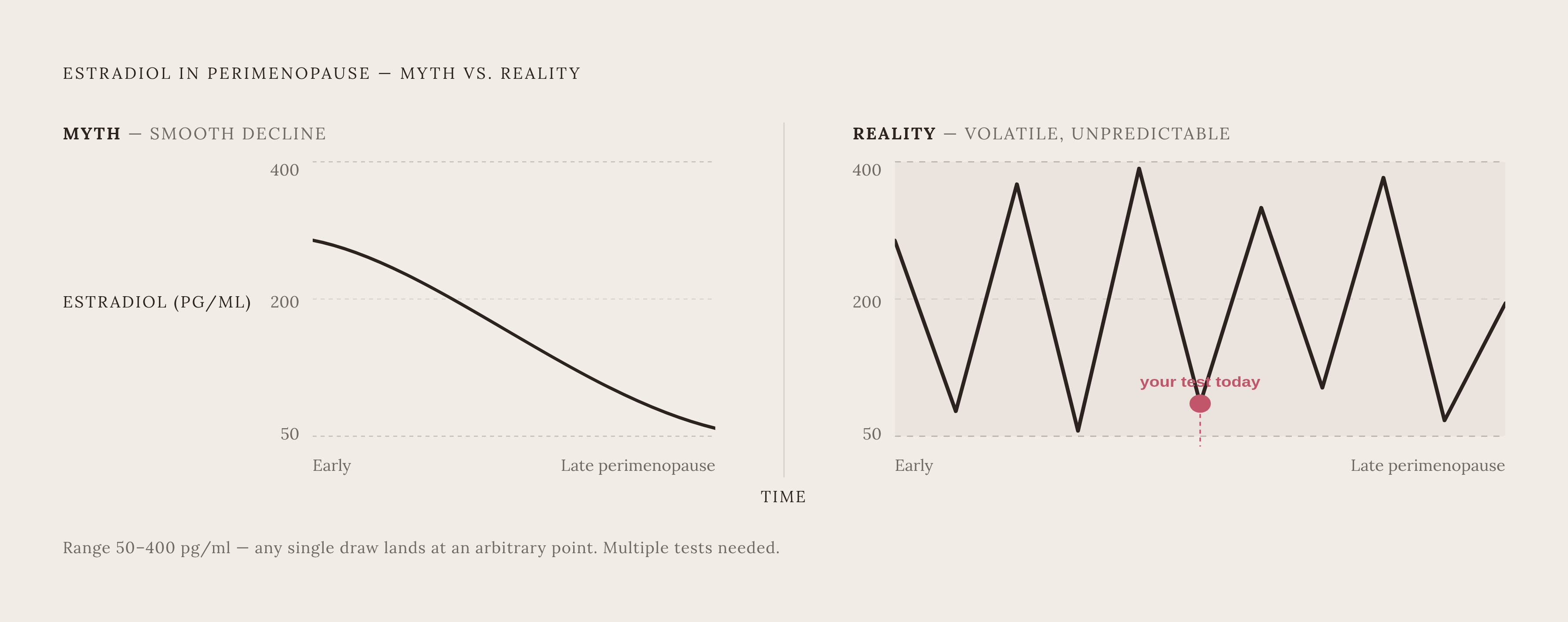
Here's the misconception worth clearing up first: most people picture estrogen as a hormone on a slow, steady downward slide until it eventually runs out. That's not what happens, at least not in early perimenopause. Estradiol (E2), the primary form of estrogen produced by the ovaries, doesn't decline in a straight line. It surges and crashes, sometimes within the same month, and that volatility, not a simple deficit, is what drives most of the symptoms women report.
The numbers show just how wide this swing gets. Estradiol during perimenopause can range from 50 to 400 pg/ml, a span so broad that a single blood draw on a single day might land anywhere in that range and still tell you almost nothing about the bigger picture.
To understand why this happens, look at what's going on with ovulation itself. As ovarian function starts to decline, ovulation becomes less consistent, and some cycles skip it entirely. Without a reliable ovulation, the luteal phase, the second half of the cycle, produces less progesterone than it used to. Estrogen, meanwhile, isn't dropping in tandem. It can spike unpredictably, sometimes higher than a woman's typical baseline, then fall sharply. FSH (follicle-stimulating hormone) rises during this process too, as the pituitary gland pushes harder to get the ovaries to respond. That rise in FSH isn't a sign of failure exactly, it's the body working harder to keep the system running.
What makes this pattern so disorienting is its inconsistency. Six weeks of night sweats, followed by two months where everything feels normal, followed by a period that's suddenly much heavier than usual: that back-and-forth isn't a red flag for something separate going wrong. It's the signature of the transition itself. And because this volatility is invisible without data collected over time, a woman who gets tested on a calm day is often told her hormones look fine, even though the instability driving her symptoms is very much present a few weeks earlier or later.
What estrogen actually does in the body, and why fluctuating levels produce such varied symptoms
Why does one hormone create such a scattershot list of symptoms, touching mood, memory, joints, skin, and sleep all at once? The answer lies in where estrogen receptors actually sit in the body. They're distributed across cortical and hippocampal brain tissue, the limbic system, cardiovascular tissue, bone and muscle, and the urogenital tract. Estrogen isn't a single-system hormone, so when it fluctuates, every one of those tissues feels it.
In the brain, estradiol modulates synaptic plasticity and the connectivity between the prefrontal cortex and the limbic system, When levels swing, that connectivity gets disrupted, which helps explain the emotional reactivity and the executive-function slips, the forgotten words, the lost train of thought, that so many women report during this window.
The cardiovascular picture backs this up from a different angle. Epidemiological data consistently show that premenopausal women have a lower incidence of cardiovascular disease than men of the same age, and that this gap flips after menopause, when postmenopausal women show higher rates than men. That shift lines up with estrogen's known protective role in vascular tissue.
Bone tells a similar story. Estradiol is positively associated with bone mineral density, and as estradiol fluctuates and eventually declines, osteoclastic activity, the process that breaks down bone, increases. And in the brain, longer term, the stakes get even higher: an estimated 7 million people in a certain country. live with Alzheimer's disease, and roughly 2 out of every 3 cases occur in women. Coverage from NBC News in November 2025 pointed to research into estrogen's neuroprotective "critical window" during perimenopause as one of the more active areas of inquiry into that disparity.
None of these are separate problems. They're different tissues responding to the same underlying hormonal instability, which is exactly why perimenopause symptoms feel so diffuse and hard to pin on any single cause.
The role of progesterone and FSH in shaping the early-forties symptom picture
Estrogen gets most of the attention, but progesterone's decline is arguably just as disruptive, especially in the early forties. Progesterone supports cycle regularity and balances out estrogen's effects, and it's produced primarily after ovulation occurs. As ovulation becomes less reliable in early perimenopause, progesterone production drops, even in cycles where estrogen is still spiking or running relatively high.
That imbalance between the two hormones, not simply "low estrogen" on its own, is what's implicated in heavy periods, disrupted sleep, and mood instability during this stage. Progesterone's metabolites have a calming, GABAergic effect on the nervous system, so when progesterone falls, that calming influence falls with it, contributing to anxiety and a shorter emotional fuse. Research points to progesterone being effective not just once a woman reaches menopause, but during perimenopause itself, precisely when estrogen levels are still high and unpredictable.
Cortisol enters the picture here too. Research has found that cortisol tends to rise as estrogen and progesterone decline, meaning the body's primary stress hormone climbs just as the hormones that would normally buffer stress are becoming less reliable.
FSH deserves a closer look on its own mechanics. As ovarian function declines, the pituitary gland receives less negative feedback, so FSH rises. That rise reflects the pituitary working harder to trigger an ovulation the ovaries are increasingly less able to complete. But FSH itself fluctuates throughout perimenopause, which means a single high reading doesn't confirm the transition has started, and a single normal reading doesn't rule it out either.
The symptoms women in their early forties actually report, and the ones they don't expect
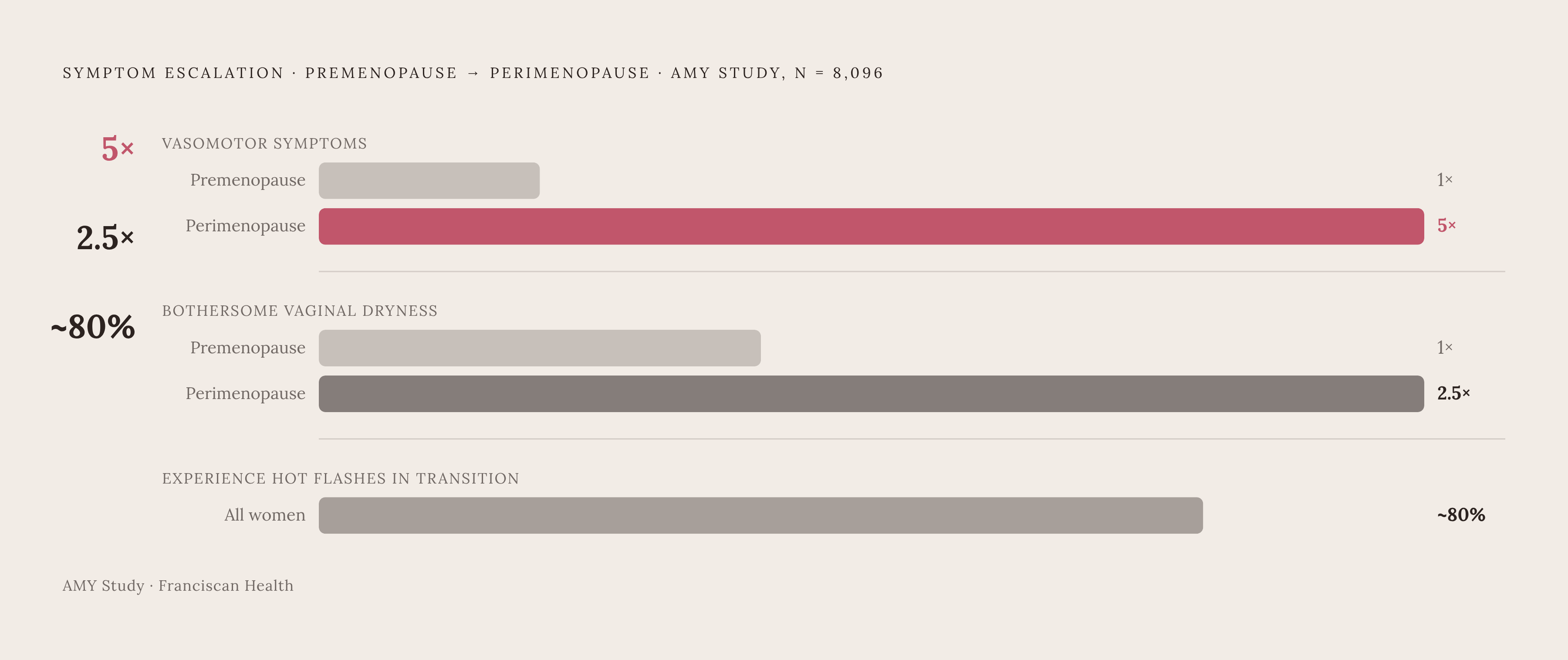
Cycle disruption is usually the first thing women notice: periods that arrive a week early or late, flow that's suddenly heavier or lighter, cycles skipped altogether. From there, vasomotor symptoms, hot flashes and night sweats, tend to define the clinical picture more than anything else. Data from the Australian Women's Midlife Years (AMY) Study, which included 8,096 respondents, found that moderately-to-severely bothersome vasomotor symptoms were 5 times more prevalent during perimenopause compared to premenopause. Bothersome vaginal dryness was 2.5 times more prevalent over that same comparison. Separately, Franciscan Health has noted that around 80% of women experience some form of hot flash during the transition.
Cognition takes a hit too, though in a subtler way than most people expect. Research indicates that cognitive function, including memory and processing speed, can be affected during perimenopause.
Mood and psychiatric symptoms follow a similar arc. The perimenopausal and early postmenopausal period is associated with new onset or worsening of mood disorders, and in some cases, new cognitive complaints that weren't present before. Anxiety in particular has been climbing on a population level: a study by Zhang and colleagues, published in BMC Women's Health, found the global age-standardized disability rate for anxiety in perimenopausal women rose from 625.51 to 677.15 per 100,000 between 1990 and 2021, with projections estimating it could reach 1,180.43 per 100,000 by 2035, a 40.67% increase from the 2021 figure.
Then there's the list of symptoms women rarely connect to hormones at all: migraines, heart palpitations, joint and muscle aches, tingling sensations, changes in body odor, dry eyes, bloating, and changes in the urogenital tract and skin. Body composition changes belong on this list too. Fat gain around the abdomen, along with muscle and bone loss, gets chalked up to diet or aging far more often than it gets connected to the hormonal shift actually driving it.
The variability itself, feeling fine for two months and then hit with three weeks of insomnia, is not a sign that something else is going on. It's the expected texture of hormonal volatility, not a deviation from it.
Factors that shift when perimenopause starts, and why the early forties can be earlier than expected
Most people begin perimenopause somewhere between 45 and 47, with the transition typically starting 4 to 7 years before menopause itself. But that range is an average, not a boundary, and several factors push the timeline earlier for a meaningful number of women.
Family history is one of the strongest signals. Perimenopause timing tends to run in families, so a woman whose mother entered the transition in her mid-forties has a reasonable chance of following a similar path. Smoking shifts the timeline too: smokers generally reach menopause 2 to 3 years earlier than nonsmokers, which pulls the onset of perimenopause earlier as well. Cancer treatments, chemotherapy and radiation specifically, can accelerate or directly trigger early perimenopause. And roughly 5% of women experience natural early menopause between ages 40 and 45, which means their perimenopause may have begun back in their mid-to-late thirties.
Some conditions complicate the picture rather than shift it outright. PCOS can produce irregular cycles that look a lot like early perimenopause on the surface, and thyroid dysfunction overlaps heavily with perimenopausal symptoms, hot flashes, fatigue, mood changes, weight shifts. Sorting out which is which requires clinical differentiation, not guesswork.
So a woman experiencing real symptoms at 41 or 42 isn't necessarily premature, and she isn't experiencing something pathological by default. Her family history, her lifestyle, or simply her individual biology may place her exactly where the science would predict. One added wrinkle worth knowing: women who enter the transition earlier tend, on average, to experience a longer overall duration of perimenopause, not a shorter one.
Why a single hormone test taken at one point in time rarely gives a clear answer
Here's a scenario that plays out constantly: a woman brings real, disruptive symptoms to her doctor, gets a blood panel done, and is told her hormones look normal. She leaves with no explanation and, often, a suggestion that the symptoms might be stress.
Why does this happen so often? Because hormone levels in perimenopause don't just decline, they swing, and a single snapshot in time has a good chance of landing on a comparatively stable day. That single data point misses the volatility that's actually producing the symptoms.
FSH illustrates the problem well. A high FSH reading can point toward perimenopause, but because FSH swings throughout the transition, a normal result on one particular day doesn't rule it out, according to guidance from the Cleveland Clinic. Clinical guidance goes further and advises against relying solely on lab tests to diagnose perimenopause. Estradiol has the same limitation: a reading anywhere across that 50 to 400 pg/ml range might come back "within range" and still represent a dramatic shift from that individual's own baseline.
AMH (anti-Müllerian hormone) gets discussed as an alternative marker since it tends to decline before FSH rises, which could reflect changing ovarian reserve. But clinical guidance cautions against using AMH to diagnose perimenopause or to pin down when menopause will arrive in routine care. Clinical consensus lands in a similar place: perimenopause can usually be identified using age, symptom pattern, and cycle changes, without routine hormone testing being necessary for most women.
So a single test result isn't a verdict. It's one data point, and a data point without context, what was happening in the cycle that day, what the trend has looked like over the preceding months, tells an incomplete story at best. What actually holds more diagnostic value is tracking hormone levels across multiple draws, at different cycle phases and different timepoints, paired against the symptom pattern itself. That longitudinal view is what surfaces the volatility that defines the whole transition, something a single test, by design, simply can't capture.
What understanding the hormonal logic actually gives a woman in her early forties
Naming what's happening changes how it feels to live through it. A woman who understands that her FSH is rising because inhibin B is falling, or that her anxiety has a plausible link to dropping progesterone metabolites and their effect on certain brain receptors, is no longer facing a mystery. She's watching a known biological sequence play out in her own body, one that around 88% of the roughly 850 million people assigned female at birth between ages 40 and 60 globally will also experience in some form.
That doesn't make the hot flashes less disruptive or the brain fog less frustrating in the moment. But it reframes the entire experience: not a personal malfunction, not premature aging, not something to be talked out of by a normal-looking lab result. It's a well-documented transition with a hormonal logic that researchers have been mapping for decades, one where the fluctuation itself, not a steady decline, is the mechanism driving nearly everything a woman in her early forties might notice happening to her body.