Testosterone's Role in Female Hormonal Health During Midlife
Testosterone drives bone, muscle, and brain function, not just desire.
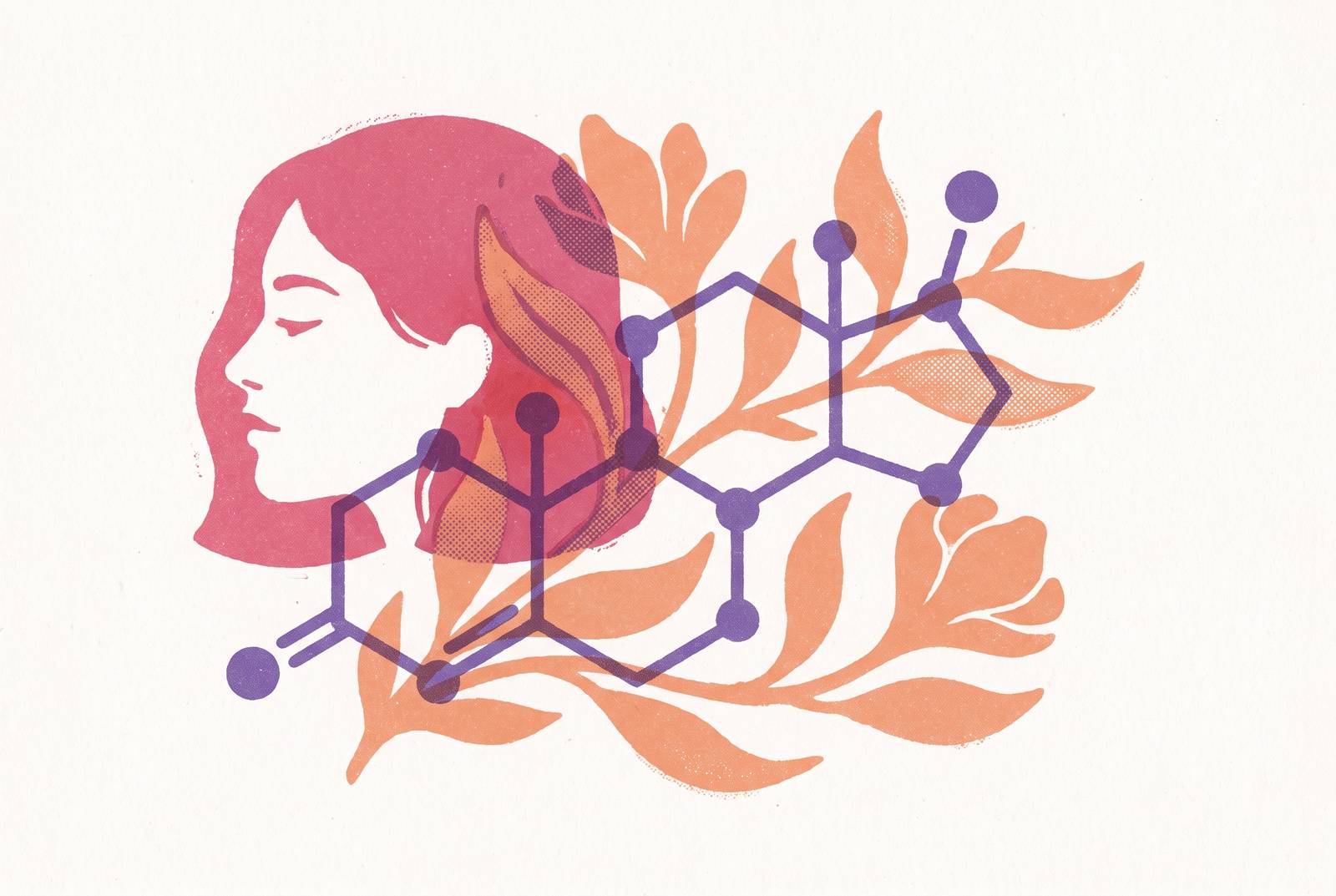
What testosterone does throughout the female body
Testosterone, not estrogen, is the most abundant biologically active hormone circulating in the female body. That single fact, supported by research published through the European Society of Medicine, should reorder how anyone thinks about women's midlife health. It does not, because that research found testosterone, not estrogen, to be the most abundant biologically active hormone circulating in the female body, which contradicts the common assumption that estrogen holds that role.
Testosterone receptors sit in tissue across the brain, bone, bladder, pelvic floor, muscle, and skin. A hormone with receptors distributed that widely is not a supporting player to estrogen, confined to some footnote about libido. It is systemic, and treating it as a niche concern is the first mistake most midlife hormone care makes.
Start with desire, since that is the association most people already carry. Testosterone activates dopamine pathways in the hypothalamus, which is part of why some clinicians call it the hormone of desire. That framing is accurate but incomplete, and stopping there is how the rest of testosterone's job gets ignored. In women too, it acts as an anabolic hormone, supporting skeletal muscle protein synthesis the same way it does in men, just at different concentrations. It contributes independently to bone mineral density, apart from whatever estrogen happens to be doing. A trial out of Monash University found early evidence that testosterone may help protect verbal memory in postmenopausal women. Promising, not proven. That distinction matters and gets collapsed constantly in how these findings get talked about publicly.
Mood and motivation are harder to measure but no less real. Testosterone modulates executive function, the capacity to start a task and carry it through under effort. When it declines, women often describe the change not as a nameable symptom but as a general sense of not feeling like themselves. That phrase appears repeatedly in clinical conversations, and it matters precisely because it resists easy categorization. Add the urogenital tissues to the list: the vulva, bladder, and urethra all carry testosterone receptors, so its decline plays into urinary and pelvic changes that get blamed on estrogen alone almost by default.
None of this requires virilizing effects to matter. At doses appropriate to female physiology, DeRosa's work notes the risk of masculinization is minimal. So why does the conversation about testosterone in women still default to fear of a male hormone gone rogue? Some of that is historical, and the last section of this piece deals with that directly. But a good deal of it is structural: because testosterone touches so many systems, its symptoms get divided up and handed to separate specialists. Psychiatry takes the mood piece. Rheumatology takes the joint and muscle piece. Urology takes the bladder piece. Almost no one asks whether one hormonal thread connects all three, and that fragmentation, more than any single misunderstanding, causes testosterone deficiency in women to stay invisible for so long.
How and when testosterone declines
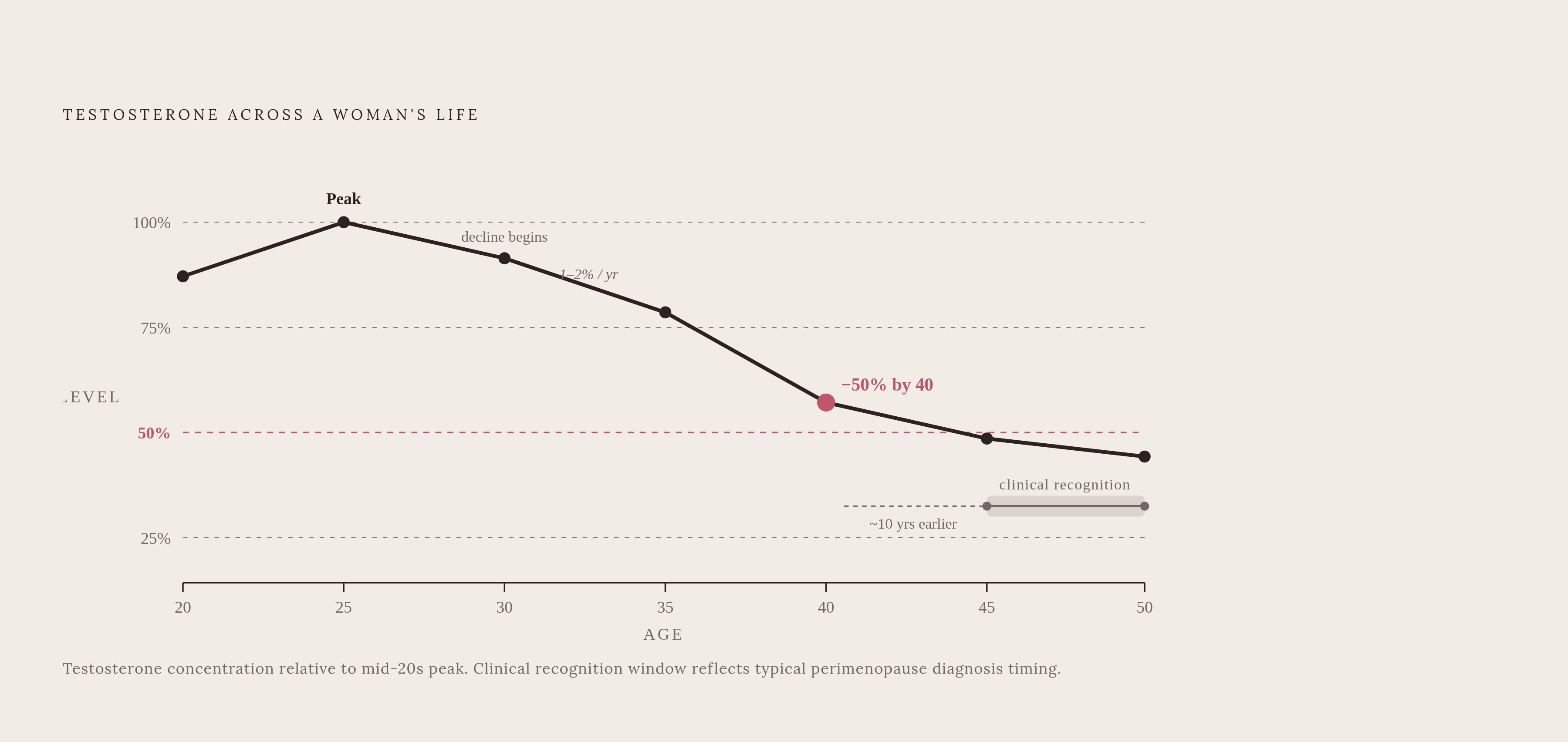
Testosterone peaks in a woman's mid-20s, and the decline starts earlier than most people assume, well before anyone is thinking about perimenopause. Figures cited by psychiatryforwomen.org show that by the early 30s, levels are already falling at roughly 1 to 2 percent a year. Slow and nearly invisible at first, but the arithmetic compounds. Healthhighroad.com reports that by 40, testosterone has often dropped around 50 percent from its peak, years before the cycle irregularity or hot flashes that usually prompt the word perimenopause to enter the conversation.
That timing gap is the actual problem. A woman in her late 30s dealing with fatigue, flat mood, stalled libido, and trouble holding onto muscle mass is living through a real hormonal shift, a full decade ahead of the symptoms that would normally get her a diagnosis. The decline and the clinical conversation about it are simply running on different clocks, and the gap between them is where a lot of unexplained suffering piles up.
Perimenopause accelerates things further, since ovarian hormone production turns erratic during that transition. By menopause, testosterone may be roughly half its peak value, again per psychiatryforwomen.org. The ovaries continue to produce some testosterone even after estrogen production drops substantially, though their contribution is significantly diminished. That is part of why surgical menopause, specifically bilateral oophorectomy, tends to hit harder and faster: the ovarian contribution disappears all at once instead of tapering, and the body gets no runway to adjust.
The symptoms that low testosterone produces
This is where the paradox turns into a practical problem. Research links declining testosterone to fatigue, anxiety, cognitive fog, musculoskeletal weakness, sexual dysfunction, and metabolic changes, symptoms that routinely get filed under mood disorders or chronic pain instead. Donovitz's research, published through NCBI and PMC, adds hot flashes, night sweats, decreased libido, irritability, depression, poor memory, poor concentration, insomnia, joint pain, vaginal dryness, and urinary complaints to that same list.
Look at that list again. How many of those symptoms also sit on the diagnostic checklist for depression? For hypothyroidism? For plain iron deficiency? Nearly all of them, and that overlap is a big reason testosterone is rarely the first thing a clinician tests when a woman in her late 30s or 40s walks in describing fatigue and low mood. The picture reads as too generic to point at one hormone, so it gets triaged toward whichever diagnosis is easiest to code and treat that day.
The misattribution follows patterns specific enough to name. Fatigue gets chalked up to workload or bad sleep. Flat affect gets called a mood disorder, sometimes earning an antidepressant prescription with no hormone panel run. Muscle weakness and joint aches get filed under normal aging or, sometimes, fibromyalgia. Cognitive fog gets blamed on stress or on "perimenopause" treated as a vague catch-all rather than something tested for directly. Low libido gets handed off to a relationship explanation or a psychological one.
Part of why this keeps happening is structural rather than habitual: there is no FDA-approved reference range for low testosterone in women. Without a threshold to anchor a diagnosis to, clinicians have nothing concrete to test against, so real physiological symptoms stay untethered from their actual cause. A study published in npj Women's Health found 55.4 percent of women between 30 and 35 reported moderate to severe perimenopausal symptoms, a figure suggesting the symptom burden starts well before the clinical conversation usually does.
The role of SHBG and free testosterone in testosterone testing
Testing total testosterone and stopping there is like measuring how much water sits in a reservoir without ever checking whether the floodgates are open. Most circulating testosterone binds to sex hormone-binding globulin, or SHBG, and bound testosterone cannot act on tissue. Figures from testing.com put the SHBG-bound fraction at somewhere between 66 and 78 percent in women at any given time. Only the unbound, free fraction reaches receptors and actually does anything, which makes total testosterone, on its own, close to the wrong number to be looking at.
That distinction should change how lab results get read, but often it does not. A woman can carry a total testosterone level that looks perfectly normal on paper while running a genuine deficiency, if her SHBG happens to be elevated. Estrogen itself drives up SHBG production, so a perimenopausal woman riding out estrogen swings may see her bioavailable testosterone shift even while her total testosterone number holds dead steady. The reverse happens too: low SHBG, often tied to insulin resistance, which becomes more common in midlife, leaves more testosterone unbound and pushes the picture the other direction.
Free testosterone, measured directly or calculated from total testosterone and SHBG, is the number that reflects what tissue is actually receiving. Reference ranges shift by lab and assay, but free testosterone in women generally runs around 0.3 to 4.2 pg/mL, while total testosterone typically falls between 15 and 70 ng/dL, dropping to roughly 7 to 40 ng/dL after menopause. Standard immunoassays, the most common testing method, were built to detect the far higher concentrations found in men, and at the low concentrations typical in women, these assays lose accuracy fast. Mass spectrometry, specifically LC-MS/MS, offers a more reliable read, a point cited by Paloma Health. SHBG also tracks insulin resistance and metabolic health more broadly, which makes it a useful marker on its own, well beyond its job as a testosterone modifier.
A woman who has only ever had total testosterone checked is working from an incomplete map of her own biology, one that reads as reassuring on paper while missing what her tissues actually experience day to day.
The components of a complete midlife hormone panel that includes testosterone
Testosterone read alone does not mean much. It needs company: a fuller hormonal context showing how the pieces move together, because perimenopause is rarely one hormone declining in a neat straight line.
A useful panel starts with total testosterone as a baseline, though as established, that number by itself is insufficient. Free testosterone, measured directly or calculated using SHBG, shows what tissue is actually receiving. SHBG explains the gap between the total and free numbers and doubles as a marker of metabolic health in its own right. Estradiol matters too, since it swings unpredictably during perimenopause, sometimes spiking higher than expected before dropping, which then moves SHBG as well. Progesterone tends to decline earlier and more steadily than estrogen, and a low reading is often the clearest sign that ovulation got skipped that cycle. FSH rises as ovarian reserve declines and works as a trend marker, though a single normal FSH reading does not rule perimenopause out. That point deserves real emphasis, since plenty of women get told their hormones are fine based on one FSH draw that happened to land on a normal day.
Perimenopausal hormone levels shift meaningfully day to day, so a single blood draw is a snapshot, nothing more. The trajectory over time is what actually matters. A testosterone level that has dropped 50 percent from a woman's own peak but still sits inside a broad reference range will not register as abnormal without a prior baseline to compare it against. Tracking reveals the trend. A single test only reveals a position, and mistaking one for the other is how real deficiency gets waved off as normal aging.
Testosterone prescribing among midlife women, concentrated heavily in women ages 45 to 64, rose 2.6-fold between 2016 and 2025, according to an analysis published in JACC: Advances and cited by Paloma Health. That is a real signal of growing clinical interest. It is not, on its own, evidence that the science has caught up to the prescribing, which is exactly the question the next section has to answer honestly.
What the evidence supports for testosterone therapy, and where the science is still incomplete
One indication carries strong, repeatable evidence: hypoactive sexual desire disorder, or HSDD, in postmenopausal women, endorsed by the Global Consensus Position Statement and backed by eleven major medical societies, including the International Menopause Society and The Endocrine Society. The data here show consistent, moderate gains in sexual desire, arousal, pleasure, and orgasm when testosterone is added to hormone replacement therapy in postmenopausal women diagnosed with HSDD. That is the one place the evidence is settled enough to build a treatment decision on.
Everywhere else, the evidence thins out fast, and this is where the honest position has to depart from how testosterone gets marketed. The Global Consensus Position Statement says that data remain insufficient for energy, cognition, mood, weight, and general well-being, despite these being some of the most heavily promoted benefits of testosterone therapy in practice. The Monash University trial mentioned earlier suggested a possible benefit for verbal learning and memory in postmenopausal women not using estrogen therapy, which is encouraging on its face, but larger confirmatory trials on cognition, bone density, and muscle mass outcomes simply do not exist yet. Anyone prescribing or seeking testosterone for those benefits specifically is acting ahead of the data, not on it.
Breast cancer risk deserves honest treatment here too, because the research has shifted direction. Earlier studies raised concern; more recent data point the other way. DeRosa's 2025 work reviewed a 9-year retrospective study of 2,377 women treated with testosterone or testosterone and estradiol pellet implants, finding a 35.5 percent reduction in invasive breast cancer incidence compared with age-matched SEER rates, consistent with antiproliferative and anti-estrogenic effects on breast tissue. That finding matters, but it comes from one research group using a retrospective design, and treating it as settled science ahead of a prospective trial would be a mistake in the other direction.
No approved testosterone formulation exists for women from the medicines regulator in question. Where treatment is clinically appropriate, it usually means using male-formulated products off-label, dosed at a small fraction of what a man would receive. Roughly 1 in 280 midlife women now carries a testosterone prescription, per the JACC: Advances analysis cited by Paloma Health, a rate that has clearly outrun the safety data behind it. Pellet implants and injections in particular are formats the Global Consensus Position Statement recommends against for women, since they make dose control difficult and often push hormone levels into supraphysiologic territory, with real risks like acne, unwanted hair growth, and voice changes.
Roughly half of women prescribed testosterone in that same analysis already carried documented cardiometabolic risk factors. The cardiovascular effects of testosterone therapy in women remain an open question, not a settled one, and treating it as settled in either direction, safe or risky, gets ahead of what the data can currently support. Testosterone therapy has real evidence behind it for HSDD specifically. It does not yet have that same evidence for the broader wellness case currently being made around it, and that gap between the narrow approved use and the wide cultural marketing is the single most important distinction in this entire conversation.
The absence of testosterone from women's perimenopause care
The roots of this gap trace back to a binary that never matched the underlying biology: testosterone got labeled the male hormone, estrogen the female one, and that framing shaped decades of medical training and public understanding. It was wrong from the start. Testosterone was used clinically in women as early as 1939, and several countries eventually licensed it for female use, with one nation issuing formal nationwide approval only in 2020. Donovitz's research through NCBI shows that the country central to this analysis, by contrast, still has zero approved testosterone formulations for women from its medicines regulator, against more than 30 approved for men.
The Women's Health Initiative findings, published in 2002, cast a long shadow over all of this. According to Donovitz's analysis, HRT prescriptions dropped more than 60 percent in the aftermath, and the caution that followed slowed research and clinical adoption across hormone therapy generally, testosterone included. That caution made sense given what the data seemed to show at the time. It also meant testosterone research for women lost momentum at exactly the moment it needed to build.
Layer a genuine measurement problem on top of that history. Standard immunoassays were built around male testosterone concentrations, and levels typical in women, running 10 to 20 times lower, often fall below what these assays can reliably detect, a point raised at The Menopause Society's Annual Meeting and cited by Paloma Health. So even a clinician motivated to test runs into tools that have historically struggled to produce a number worth trusting.
Then there is the diagnostic gap, which may be the most stubborn piece of all. Male hypogonadism is a recognized, well-defined clinical condition with a name and a code. Female androgen deficiency has no equivalent: no FDA-endorsed diagnostic category, no ICD code to bill against, no accepted threshold marking where treatment should start. Without an approved indication, insurance coverage for testosterone in women stays rare, and that creates a real access barrier, one that falls hardest on women without the means to pay out of pocket for testing or treatment.
The picture that emerges is not one of missing biology. Testosterone's role in the female body has been present and measurable the entire time. What has been missing is the regulatory infrastructure, the diagnostic language, and the willingness to treat it as central rather than incidental to women's health, and none of those gaps close on their own. Closing them starts with a plain admission: the most abundant active hormone in a woman's body is also the one her healthcare system has spent the least time trying to understand.