Wearable and Lab Data Integration in Women's Hormonal Health Monitoring
Wearables and blood tests measure different things; using both strategically matters most.
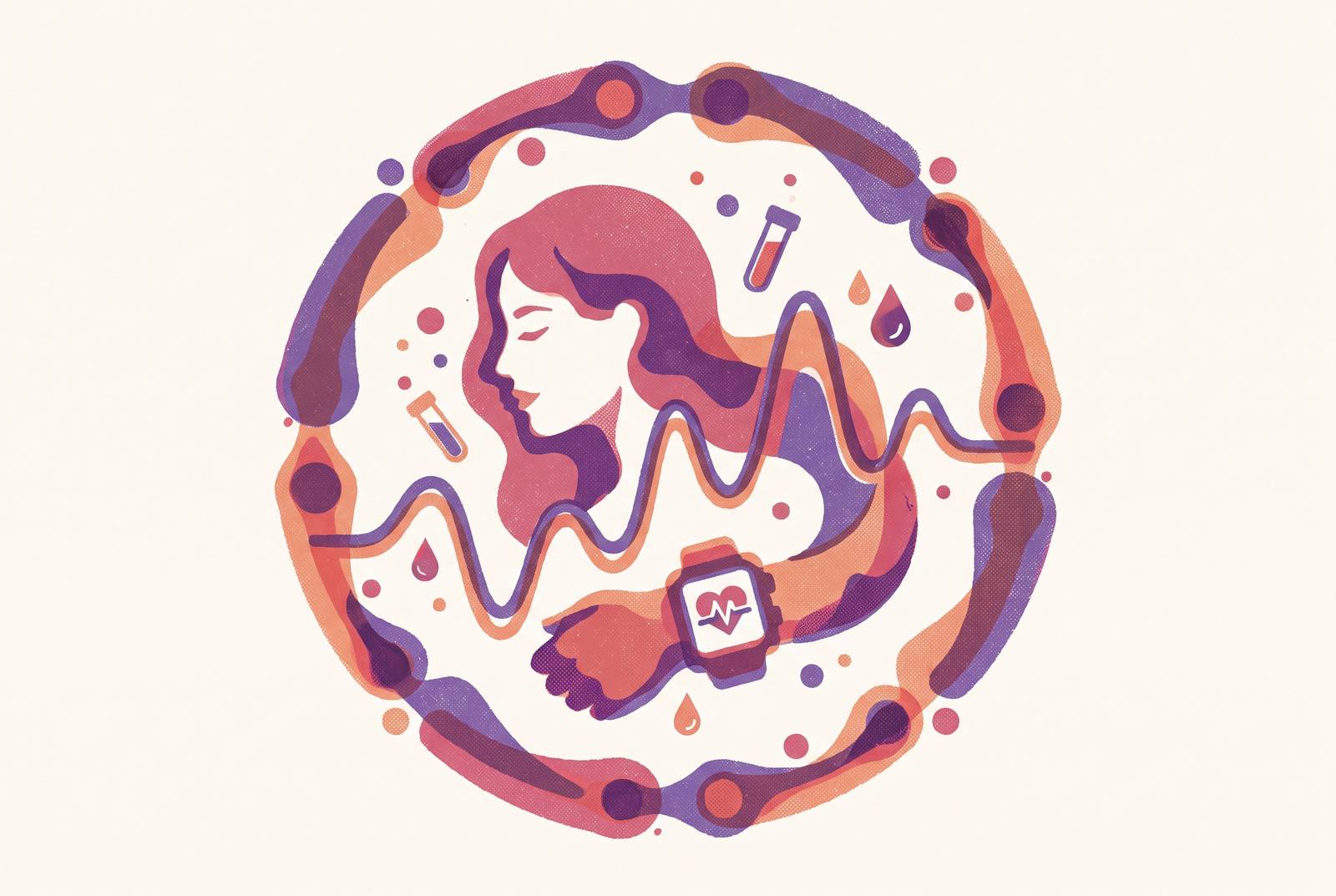
Wearables and lab tests measure two different things during perimenopause, and most of the confusion around hormone tracking comes from treating them as competing versions of the same measurement. A wearable infers what the body might be doing from signals on the skin. A lab test measures what a hormone is actually doing in blood, at one moment, in one draw. The moment someone starts using a temperature trend to override a lab result, or a single blood draw to dismiss six weeks of tracked symptoms, the whole monitoring strategy falls apart, and figuring out which tool to trust for which question is the actual work of managing this transition.
Wearables and lab tests answering different questions about hormonal health
Wearables used to track steps and heart rate during a workout. Now they claim to detect ovulation, cycle phase, and hormonal shifts tied to perimenopause, and that claim has put them in direct, if informal, competition with blood-based hormone panels. The overlap is mostly marketing. It has created a real problem: women, and sometimes clinicians too, start treating a wearable's temperature reading or an HRV trend as though it carries the same weight as a lab value. It does not, and the two are built from different kinds of data.
A wearable collects continuous physiological signals: skin temperature, heart rate variability, and sleep architecture, sampled continuously throughout the day. A lab panel measures something else entirely, the concentration of a specific hormone (estradiol, FSH, progesterone, AMH, LH, inhibin B) in blood, at one moment. Each of those hormones has its own half-life, its own reference range, its own behavior across a cycle. Neither stream is better than the other. They sit at different resolutions and different timescales, and the mistake is treating one as a substitute for the other rather than using each for what it actually does.
Perimenopause's Effects on Hormones Over Time and the Resulting Monitoring Challenges
Perimenopause averages around four years, but the real range runs from two to ten, and where a woman falls on that range depends heavily on when she starts. Women with the youngest onset face a median transition length of 8.57 years, compared to 4.37 years for those in the oldest quartile at onset. That gap alone is wide enough to make almost any single monitoring approach feel inadequate at some point along the way. Most women enter perimenopause between 45 and 47, with a median onset of 47.5, but the range stretches from the mid-30s into the early 50s. The transition can begin a full decade before a woman expects it. That's a monitoring failure waiting to happen if nobody is looking for it yet.
The hormonal sequence inside perimenopause is not a smooth decline, and treating it as one is where a lot of monitoring strategies go wrong from the start. Progesterone tends to fall first, and quietly, before estradiol becomes unstable. Estradiol doesn't drop in a straight line either; it swings erratically and often spikes higher than premenopausal baseline early in the transition. Some women get high-estrogen symptoms, breast tenderness, heavy bleeding, well before they notice the low-estrogen symptoms everyone expects, like hot flashes. FSH climbs as the pituitary works harder to recruit ovulation from follicles that keep getting less responsive, and that rise reaches beyond reproductive signaling: FSH signaling appears to reach well beyond the ovaries, which raises a genuinely open question about whether FSH tracks systemic aging as much as it tracks ovarian function.
AMH behaves differently from all of these, and that difference is why it deserves more weight than it usually gets. It declines progressively and stays relatively stable across the menstrual cycle, which makes it a far more dependable marker to track over months than FSH, which can swing considerably from one draw to the next for reasons that have nothing to do with the underlying trend. Cortisol complicates things further, rising across the transition and interfering with any physiological signal a wearable is trying to interpret. STRAW+10, the staging framework most clinicians work from, puts numbers around this: early perimenopause shows cycle-length variability of at least 7 days recurring within 10 cycles, and late perimenopause shows 60-plus days of amenorrhea alongside FSH consistently above 25 IU/L. Those thresholds only mean anything if someone actually tracks cycle length and tests FSH more than once, which is precisely the gap the rest of this piece works through.
The Capabilities of Lab-Based Hormone Testing Beyond Wearables
A blood draw produces a number no sensor can. Estradiol, FSH, AMH, progesterone, LH, DHEA-S, and inhibin B are chemical concentrations circulating in serum, and there's no way to back into those values from skin temperature or heart rate variability. A wearable can suggest that something hormonal is happening. A lab panel confirms what's actually happening at the biochemical level, and closing that gap between suggestion and confirmation is why blood work gets ordered.
Each marker carries its own diagnostic weight, and the stakes go past hot flashes. Estradiol confirms a hypoestrogenic state, and a study in Frontiers in Medicine, looking at perimenopausal women with hypertension, linked estradiol depletion and elevated FSH to thalamic atrophy associated with lower cognitive scores. No wearable is built to flag that kind of downstream risk. FSH supports staging, with the STRAW+10 threshold of 25 IU/L marking late transition, though it only means something read as a pattern across multiple draws, never as a single cutoff. AMH, the most stable marker across the cycle and the one that needs no day-3 timing, works as the best single longitudinal indicator of ovarian reserve available in a standard panel.
Progesterone clarifies whether ovulation actually happened in a given cycle, and its decline later in perimenopause explains mood and sleep disruption that estradiol alone doesn't fully account for. LH rises and surges irregularly through the transition. A study in Scientific Reports, covering 1,511 perimenopausal and postmenopausal women, found FSH, LH, and estradiol all significantly correlated with cholesterol and bone mineral density, tying reproductive hormone shifts to cardiovascular and skeletal outcomes that reach well beyond fertility. Cortisol, when included, helps separate HPA-axis dysregulation from primary ovarian change, and that distinction matters enormously when fatigue, anxiety, and disrupted sleep are what actually bring a woman into a clinician's office.
Testing on cycle days 2 through 4 captures something close to baseline for most of these markers, AMH being the exception since it doesn't need that kind of scheduling. And here's a pattern clinicians see constantly that rarely makes it into public conversation about hormone testing: a woman can have severe symptoms on a day when her hormone values look entirely normal, or mild symptoms on a day when her values sit well outside range. That mismatch between the biochemical picture and the lived one is a finding in its own right, and it's exactly the kind of pattern a single test, taken in isolation, cannot explain.
A single lab result as an unreliable snapshot during perimenopause
FSH can move considerably from week to week during perimenopause, sometimes dropping back into premenopausal range even after a woman has had an elevated reading. Estradiol can spike sharply before falling again days later. A single low reading proves very little on its own, and a single high reading doesn't confirm menopause either. That volatility, more than anything else, is why perimenopause resists being pinned down with one test, and it's also why chasing a single number is the wrong instinct even when the number looks alarming.
Clinical guidance has moved toward caution about routine biochemical testing to identify perimenopause or menopause in women who already present with compatible symptoms. The logic holds up: a single measurement, taken in a population where the diagnosis is already clinically obvious, rarely changes what a clinician does next. A test earns its place when it might change the course of care, not when it's ordered to validate symptoms a woman is already describing accurately.
The guidance shifts meaningfully for women under 40, and the shift itself is instructive. There, testing for menopause is generally approached with more than a single draw, given how much FSH can vary. That principle, built into how clinicians approach early diagnosis, amounts to an admission that one reading isn't enough to act on, even in a population where accuracy carries real stakes for fertility counseling and bone health. If careful clinical practice doesn't rely on a single FSH value in the group where accuracy matters most, nobody should rely on one anywhere else either.
Wearable Capture of Perimenopausal Body Signals and Its Reliability
Wearables earn their keep on certain signals. Nighttime skin temperature elevation and heart rate changes during vasomotor events, hot flashes and night sweats, leave a detectable thermal and HRV signature that continuous monitoring picks up in a way a single office visit never will. Sleep architecture is another genuine strength: total sleep time, number of awakenings, time spent in restorative stages, all of it matters given that 40% to 60% of women between ages 40 and 60 report significant sleep disturbance during this transition. Activity and recovery metrics shift with hormonal state too, across a single cycle or across months, and that longitudinal behavioral data fills gaps in women's health research that clinical studies alone have struggled to close.
The claims that go further, though, deserve more skepticism than they usually get, and this is where a lot of marketing overreaches. Cycle phase, ovulation timing, hormone surges: these are estimates. A wearable infers ovulation from a temperature shift or an HRV pattern. It does not detect an LH surge directly, the way a serum hormone draw does. Research evaluating these estimates has compared them against a mix of reference standards (urinary LH, PdG, serum hormones, ultrasound), and that inconsistency in comparators makes it genuinely hard to say how reliable any single wearable's phase estimate is across the board. Wearable-derived phase estimates haven't been checked against biochemical reference standards consistently enough to sit next to an actual hormone reading as an equivalent, and treating a temperature-based ovulation estimate as interchangeable with a serum progesterone result is the exact substitution that gets people into trouble.
Menopause and midlife health remain underdeveloped territory for this technology. Researchers have pointed to longitudinal digital monitoring as a promising way to capture vasomotor symptoms, sleep disruption, mood, fatigue, and functional decline over time, better than any single clinic visit could manage. Promising is not the same as proven, and that gap affects how much clinical weight these digital measures can carry compared to diagnosed hormonal markers. There's also a barrier that doesn't get discussed enough: many users of period tracking and reproductive health apps worry, reasonably, about where their cycle data lives, who can access it, and whether it gets sold to third parties. That concern shapes who actually sticks with these tools long enough to build a useful dataset.
Tracking symptoms and daily physiology over weeks to prepare for a more productive lab result
The first clinical visit for a woman with perimenopausal concerns tends to run on thin material. The clinician has approximate symptom recall, cycle dates reconstructed from memory, and a single lab draw from that day, which may or may not reflect her actual hormonal state given how much FSH and estradiol move during this transition. That's not much to build months or years of care on, and it remains the default starting point for so many women.
Two to three months of tracked data changes the foundation considerably. Cycle length variability, frequency of sleep disruption, mood patterns, energy trajectory: all of it turns into concrete, time-stamped information instead of a vague impression assembled in the waiting room five minutes before the appointment. This is exactly the pattern STRAW+10 is built around: cycle length changes of at least 7 days, recurring within 10 cycles, count as a diagnostic marker for early perimenopause, and that's precisely the kind of detail memory reconstructs badly.
Wearable data adds a useful layer on top of that. If a device shows consistent nighttime temperature elevation and fragmented sleep across six weeks, that pattern gives context to an FSH reading that came back elevated, or, just as importantly, one that came back normal despite obvious symptoms. Does six weeks of disrupted sleep justify a repeat panel sooner than the standard interval? Tracked physiology doesn't answer that on its own, but it sharpens the question enough that a clinician can actually act on it.
Insights from Repeated Lab Panels Beyond a Single Test or Wearable
FSH rises progressively across the menopausal transition, and AMH declines steadily as ovarian reserve diminishes. A series of panels spaced months apart reveals something a single draw never can: direction. A woman whose FSH has risen substantially over several months sits on a fundamentally different trajectory than one whose FSH has stayed flat, even though a single snapshot of either woman, taken alone, might look nearly identical on paper. That difference is the argument for repeat testing, and it's the piece a wearable cannot supply, since no sensor reports an FSH concentration.
AMH suits this kind of repeat testing particularly well, declining in a fairly predictable, progressive way across the transition. That predictability makes it one of the more practical markers for building an actual trend line rather than banking on a one-off value. Progesterone tracked across multiple cycles tends to decline quietly, before estradiol variability becomes obvious, so serial measurements can catch loss of luteal adequacy early, often well before hot flashes or other more visible symptoms appear.
Cortisol adds a dimension that gets overlooked too often. Since it rises across the perimenopausal transition, including it in a repeated panel helps separate HPA-axis dysregulation from ovarian hormonal change, or reveals whether both are happening at once. That distinction shapes what a clinician actually recommends: the focus belongs on stress physiology, hormonal support, or some combination of the two.
Where the two data streams genuinely complement each other
Wearables earn their place by watching continuously, catching thermal and sleep disruption patterns night after night, and by giving a clinician context that a single appointment can never supply on its own. That continuous view carries real value, and dismissing it just because it isn't lab-grade would be its own kind of mistake. But continuous physiological monitoring, no matter how sophisticated the sensor, stays inference all the way through. It cannot report an actual estradiol concentration, and it cannot confirm ovulation the way a progesterone draw at the right cycle day can. That limit isn't a flaw in the engineering; it's the ceiling on what skin sensors were ever going to be able to measure.
Lab panels, run once, carry the opposite limitation: precision at a single moment, inside a transition defined by volatility. When run repeatedly, spaced appropriately, and read against a woman's tracked symptoms and physiology, they start to show trajectory, where a woman's hormonal transition is actually heading. A curated blood panel captures the biochemical concentrations (estradiol, FSH, AMH, progesterone, LH, DHEA-S, inhibin B) that no wearable can infer from a skin sensor, and services like Intermission Health, which pair clinician-reviewed hormone testing with longitudinal tracking, exist for exactly this reason: a well-timed snapshot, compared against past results, surfaces staging patterns that neither a single test nor a wearable alone will ever show by itself.
Neither stream replaces the other, and the framing that pits them against each other gets the relationship backwards. If there's a wrong instinct to correct here, it's the impulse to pick a winner between the two, when the entire value comes from what each one covers that the other structurally cannot. One tracks physiology continuously and infers what might be happening. The other measures biochemistry precisely, at moments spaced out over months. Knowing what each can and cannot do is what turns two separate, sometimes contradictory-looking sources of data into an actual picture of a woman's hormonal health, instead of two competing guesses about the same body.