Cortisol and Adrenal Function Interactions With Perimenopause Hormones
Stress hormones and reproductive hormones create a destabilizing loop during perimenopause.
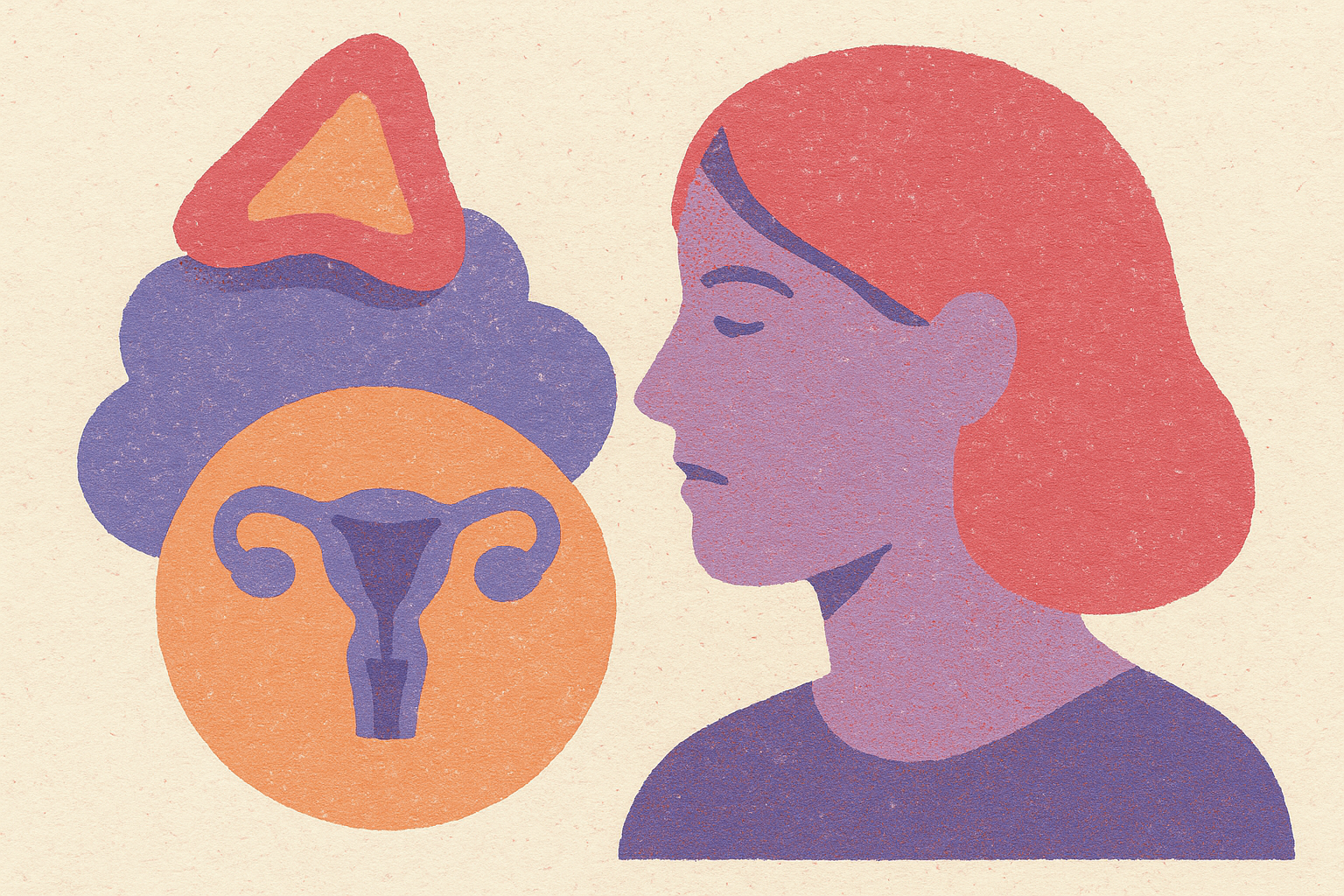
Perimenopause gets talked about like an estrogen problem with side effects. That framing misses something the endocrine data makes hard to ignore: the stress response system, the hypothalamic-pituitary-adrenal (HPA) axis, is tangled up with declining ovarian hormones in a two-way loop, not a one-way decline. Falling and fluctuating estrogen and progesterone destabilize cortisol regulation, and a destabilized cortisol pattern then makes perimenopausal symptoms worse, which is a big part of why sleep, mood, anxiety, and fatigue during this transition resist any tidy explanation.
Perimenopause, menopause, and postmenopause together touch more than a billion women worldwide at any given moment, and yet the clinical explanation offered to most of them stays thin. Up to 85% of women report at least one symptom during the transition, a number large enough to suggest that something broader than reproductive hormone decline is at work. Sleep disruption, anxiety, fatigue, mood swings, brain fog: none of these map cleanly onto a single falling hormone, and treating them as if they do is part of why so many women get told their labs look "normal" while they feel anything but.
How the HPG axis unravels during perimenopause
The hypothalamic-pituitary-ovarian (HPO) axis runs the reproductive cycle through a feedback loop, and that loop starts to break down as the ovaries' supply of primordial follicles shrinks. Fewer follicles means less inhibin, and inhibin's job is to hold back the pituitary. Take away the brake and FSH and LH both climb. That is why elevated FSH gets used as a rough marker of the transition, even though, as later sections show, it is far from a stable one.
Estradiol does not glide downward in a straight line. It swings, sometimes spiking higher than in a woman's twenties before crashing, and FSH follows a similarly erratic path rather than a clean upward slope. Progesterone tells a more one-directional story: it falls first and fastest, because it's mostly produced by the corpus luteum after ovulation, and a large share of perimenopausal cycles stop ovulating well before periods actually stop. So a woman can still be getting her period, still technically cycling, while running on almost no progesterone. That gap between "still cycling" and "still ovulating" is where a lot of the early symptom burden starts.
Progesterone's neurosteroid role and its reach into the stress response system
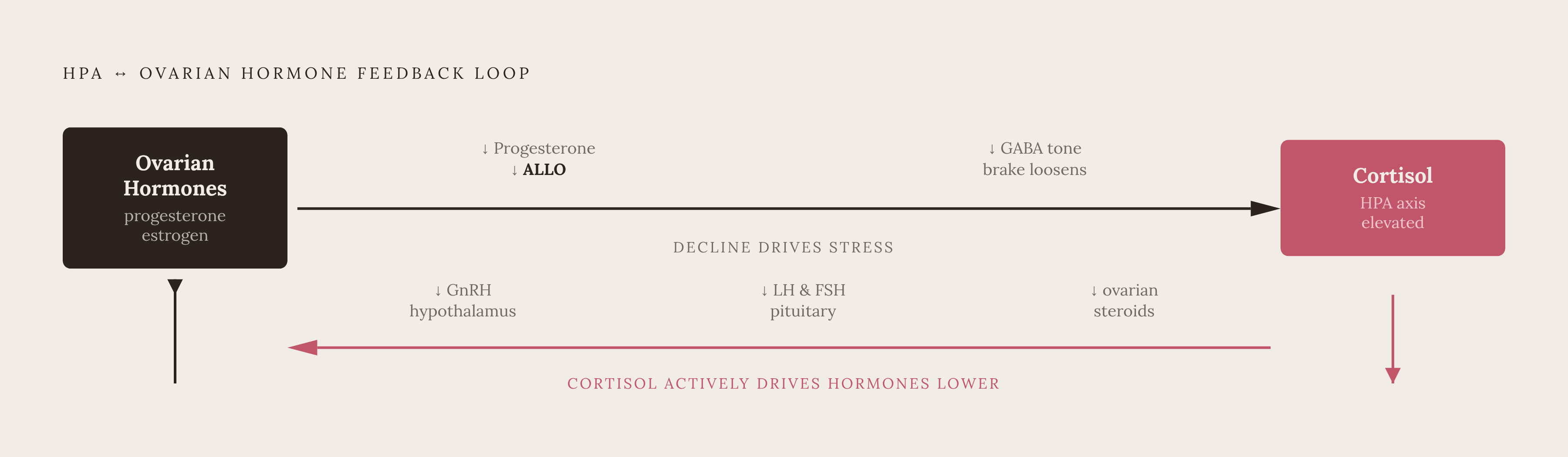
Progesterone does more than prepare the uterine lining. It's the precursor to allopregnanolone (ALLO), one of the body's main GABA-potentiating neurosteroids, and ALLO is what gives progesterone its calming, sedative, mood-stabilizing reputation. GABA is the brain's primary inhibitory neurotransmitter, so when ALLO production drops alongside progesterone, the nervous system loses a chunk of its capacity to downshift.
That loss doesn't stay contained to mood or sleep. Reduced GABA-ergic tone feeds back on the HPA axis itself, loosening the brake on cortisol output. This is the first real mechanistic bridge between declining ovarian hormones and a stress-response system that starts behaving erratically. The emphasis belongs on erratic: progesterone's calming effect becomes unreliable because production swings wildly during perimenopause instead of settling into a steady, lower baseline. A hormone that sometimes appears and sometimes doesn't destabilizes a feedback system more than one that declines predictably. The nervous system can adapt to a slope. It has a harder time adapting to noise.
How estradiol regulates the HPA axis
Estradiol (E2) isn't a passive bystander to the stress response either. It can amplify stress-induced neuronal activation, push up CRH gene expression in the hypothalamus, and make the adrenal gland more sensitive to ACTH, the pituitary signal that tells the adrenals to release cortisol. In other words, estradiol can turn up the gain on the entire HPA axis.
But estradiol works through two different receptor types, ERα and ERβ, and they pull in opposite directions. ERβ tends to dial HPA reactivity down; ERα tends to dial it up. Depending on which receptor population dominates at a given point in a woman's cycle, or in her transition, estrogen's net effect on stress reactivity can look completely different from one month to the next. That may be part of why estrogen's relationship to mood and stress resilience seems to shift across life stages rather than holding steady.
It also matters that the hypothalamus itself sits at the intersection of both systems. It governs reproductive hormone signaling and stress response through overlapping circuitry, so a disruption in one system doesn't stay politely confined to its own lane. During early perimenopause, when estradiol is swinging rather than simply dropping, its downstream effects on HPA regulation swing right along with it. That unpredictability, more than the eventual decline, may be what makes early perimenopause feel so much more destabilizing than the years that follow.
Longitudinal evidence on cortisol patterns across the perimenopausal transition
The Swiss Perimenopause Study followed 127 women, ages 40 to 56, over 13 months, collecting 11 saliva samples per participant to track estradiol, progesterone, and cortisol together. The standout finding wasn't a shared trajectory. It was the absence of one: intercepts and slopes for all three hormones varied so widely across individuals that no single pattern described the group. One woman's cortisol might climb steadily through the study period while another's stayed flat and a third's oscillated with no clear direction.
Even more telling, the study found that classifying women as early versus late perimenopausal did not reliably predict how their estradiol, progesterone, or cortisol behaved over time. That complicates a common clinical shorthand, the idea that "stage" tells a clinician what to expect from a hormone panel. It often doesn't predict how their estradiol, progesterone, or cortisol behaved over time, which complicates that clinical shorthand.
Separately, the Seattle Midlife Women's Health Study found that cortisol tends to rise during late perimenopause, tracking alongside the climb in FSH. Read together, these two studies paint a picture of a system that is individually variable but not necessarily quiet: cortisol is doing something in this window, even if the something differs from woman to woman.
The adrenal glands as a secondary hormone source when ovarian output declines
As the ovaries wind down, the adrenal glands pick up part of the slack. They continue producing DHEA and other precursors that peripheral tissue can convert into usable estrogen, taking on a compensatory role alongside their moment-to-moment stress response work through cortisol.
Those two jobs draw on the same glandular real estate, and when adrenal function is already strained by chronic stress, poor sleep, or nutrient depletion, both jobs can suffer at once. That's a competing-demand problem. And it runs in both directions, because glucocorticoids don't just get produced by this system, they act back on it. Cortisol suppresses GnRH synthesis in the hypothalamus, blunts LH and FSH release from the pituitary, and interferes directly with ovarian steroid production. So chronically elevated cortisol doesn't sit next to declining reproductive hormones as a coincidence. It can actively push them lower.
The "wired but tired" symptom cluster as a stress-system signature
Cortisol is supposed to follow a diurnal curve: high on waking, tapering through the day, close to its floor by bedtime. Falling asleep and staying asleep both depend on hitting that low, parasympathetic-dominant state in the evening. When the curve flattens, or the evening dip fails to show up, the nervous system stays tilted toward sympathetic, fight-or-flight activation right when it's supposed to be winding down.
That mismatch is what "wired but tired" actually describes. Mind racing at 11pm despite exhaustion, waking at 3am fully alert for no discernible reason, sleep that technically happens but never feels restorative: these are stress-system signatures, distinct from the vasomotor symptoms (hot flashes, night sweats) that get most of the attention. And the mechanism compounds itself. Without the calming chemical support described earlier that progesterone normally provides, the nervous system has less chemical capacity to downshift even on nights when cortisol isn't obviously elevated. Two systems that each individually made sleep easier are both compromised at the same time.
An important clinical boundary: what "adrenal dysregulation" means here
None of this amounts to adrenal insufficiency. Addison's disease and secondary adrenal insufficiency are specific, diagnosable medical conditions involving genuinely low cortisol, and they require their own clinical workup separate from anything discussed here. Perimenopause does not, on its own, push the adrenal glands into that kind of failure.
"Adrenal fatigue" isn't a validated clinical diagnosis, even though the symptoms attached to it, exhaustion, brain fog, low resilience, waking up tired, overlap heavily with both perimenopause and HPA dysregulation. Feeling depleted is not, by itself, evidence that cortisol is too low. More often the actual pattern is a disrupted rhythm: cortisol spiking at the wrong moments, going flat at others, rather than sitting uniformly below where it should be. The clinically meaningful concept here is HPA axis dysregulation: an altered rhythm, altered reactivity to stress, or a blunted cortisol awakening response. These are measurable. They don't require reaching for a diagnosis that professional endocrinology bodies don't recognize.
The incomplete picture from a hormone panel that omits cortisol and adrenal markers during perimenopause
Clinical guidance has generally advised against routine biochemical testing just to confirm perimenopause in women over 45 who already show compatible symptoms, resting diagnosis in that group on clinical history instead. That guidance is often misread as "testing doesn't matter." It says something narrower: a test should be ordered because it will change what happens next, not simply to confirm a story the symptoms already tell.
Testing becomes useful once a woman and her clinician are trying to understand what's actually driving her symptoms. FSH, LH, estradiol, and progesterone all move enough within a single cycle, sometimes within a single week, that one blood draw can miss the pattern. A snapshot might catch estradiol on a high day or a low day and tell two completely different stories about the same woman. A panel built for this transition typically covers estradiol, progesterone, FSH, LH, testosterone, DHEA-S, and AMH, each one measuring a different piece of reproductive and metabolic function. Leave cortisol and adrenal markers out of that panel: the picture is missing the exact system this piece has been describing, the one that both responds to and shapes everything the reproductive hormones are doing.
What understanding this system interaction means for women navigating perimenopause
The bidirectional loop between the HPA and HPG axes explains something that generic perimenopause advice tends to skip past: why symptoms resist being pinned on one cause, and why that resistance so often gets read by clinicians, and by women themselves, as vague or unserious. It's a specific, describable pattern. It's a system with more than one moving part, and the parts move at different speeds.
Women who understand that sleep trouble, anxiety, and fatigue might reflect a stress-response system under strain, not just "hormones" in some undifferentiated sense, are in a stronger position to ask pointed questions in a clinical visit rather than accepting a shrug. The right response to that complexity is to track the full picture over time. It's to track the full picture over time, watching how estradiol, progesterone, FSH, and cortisol-related markers move relative to each other rather than in isolation. Because individual trajectories vary as much as the Swiss Perimenopause Study found, a single test on a single day tells a woman what her hormones were doing that morning, not what pattern they're actually following, so that kind of longitudinal view is essential here. Services built around that kind of tracking, including Intermission Health, aim to surface a woman's personal cortisol-and-ovarian-hormone signature over time, which is what makes it possible to tell true dysregulation apart from ordinary perimenopausal noise.
Standard wellness advice, sleep hygiene, stress reduction, isn't wrong. It targets real mechanisms. But it falls short when the cortisol rhythm is already dysregulated at a physiological level, because no amount of willpower resets a flattened diurnal curve. What that takes instead is a nervous system intervention that actually changes state, paired with a clear enough picture of what's happening hormonally to know which lever is worth pulling first.
Sources
- Stress, Cortisol, and the HPA Axis in Perimenopause - Beata Lewis MD
- Cortisol & Its Impact on Menopause (W/ Tips to Manage Cortisol)
- Steroid Hormone Secretion Over the Course of the Perimenopause: Findings From the Swiss Perimenopause Study
- researchgate.net
- Frontiers | The role of the hypothalamic-pituitary-adrenal axis in depression across the female reproductive lifecycle: current knowledge and future directions
- Exploring the effects of estrogen deficiency and aging on organismal homeostasis during menopause
- Puberty and perimenopause: Reproductive transitions and their implications for women's health - ScienceDirect
- journals.physiology.org